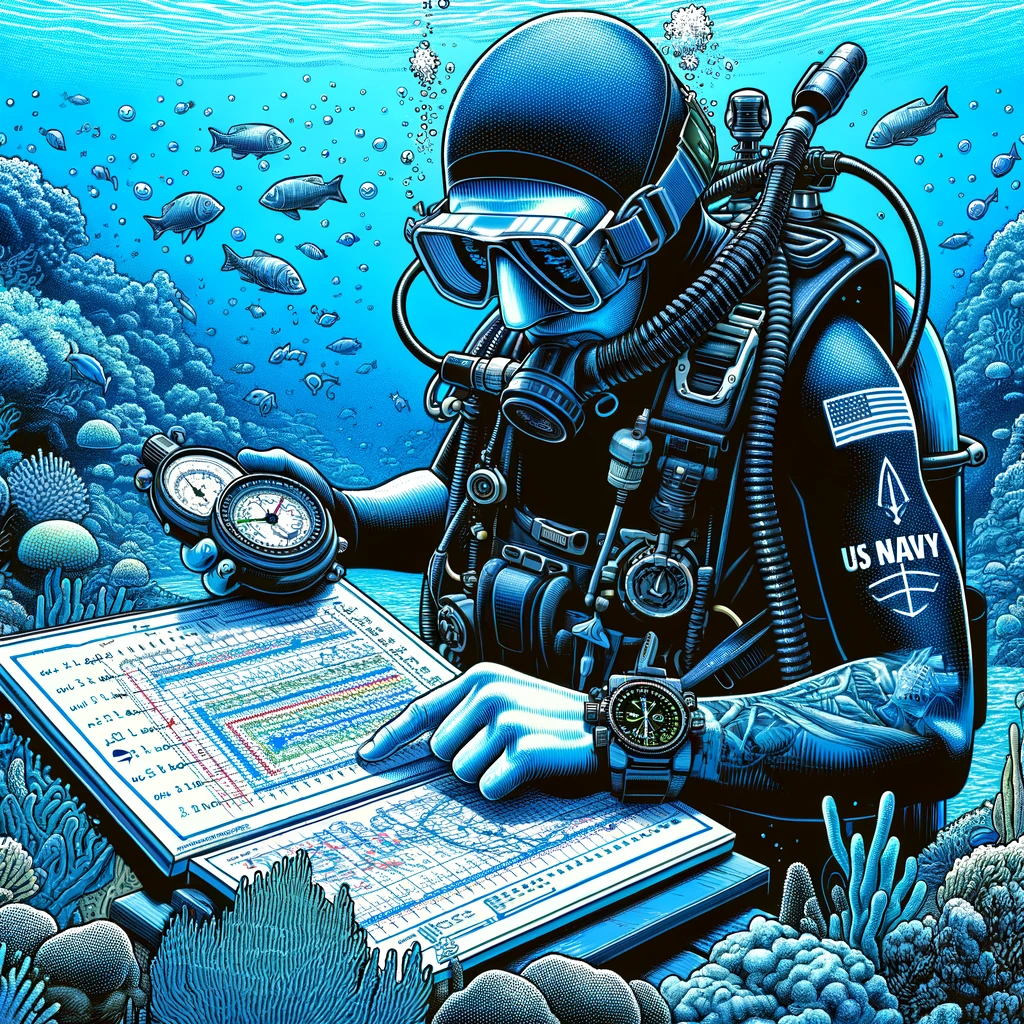
As a diver, the allure of the underwater world is matched only by the respect we must hold for its inherent risks. Chief among these is decompression sickness, a concern adeptly managed through the use of dive tables. Today, we delve into the US Navy Dive Tables, exploring their application in various scenarios: minimum decompression, planned decompression diving, and altitude diving.
PDF of the US Navy Dive Tables HERE:
1. Minimum Decompression Diving
Understanding the Tables
The US Navy Dive Tables are designed to keep divers within safe limits of nitrogen absorption. In minimum decompression diving, these tables help plan dives so that divers can ascend without mandatory decompression stops.
How to Use
- Determine Depth and Bottom Time: Check the depth of your intended dive and the planned bottom time.
- Refer to the Table: Find your depth on the table, and trace across to find the maximum bottom time allowed for that depth without requiring decompression stops.
- Safety Margin: Always plan to surface with a safety margin, never pushing the limits of the table.
2. Planned Decompression Diving
When to Use
Planned decompression is used for deeper or longer dives, where nitrogen absorption exceeds the no-decompression limits. DO NOT attempt a planned decompression dive without proper Technical Diving training and certification. You can become certified in planned decompression diving through multiple agencies, include GUE, IANTD, and TDI. You can often do Decompression Procedures and Advanced Nitrox training at the same time; enabling you to accelerate decompression using enriched oxygen mixes up to 100% O2.
How to Use
- Plan Your Dive: Determine your depth and bottom time. This will be longer or deeper than the no-decompression limits.
- Consult the Table: Use the US Navy Dive Tables to calculate the required decompression stops. These stops, at specific depths for specified times, allow nitrogen to safely off-gas from your body.
- Dive Plan Execution: Follow your dive plan and decompression schedule strictly. Any deviation can increase the risk of decompression sickness.
3. Diving at Altitude
The Challenge
Diving at altitude differs due to the reduced atmospheric pressure, affecting the way nitrogen is absorbed and released from the body.
Adjusting Dive Plans
- Altitude Adjustment: Use the US Navy Dive Tables specifically designed for altitude diving. These adjust for the reduced atmospheric pressure.
- Plan Accordingly: Altitude tables will often result in reduced bottom times or increased decompression requirements for the same depth at sea level.
Conclusion
The US Navy Dive Tables are an essential tool in a diver’s kit. Whether you’re planning a leisurely reef dive, a deep wreck exploration, or a high-altitude adventure, these tables are your guide to a safe return to the surface. Remember, the ocean is as unforgiving as it is beautiful. Plan your dive, and dive your plan.
 Deco Stops
Leave a comment